
Why three different U.S. trade authorities are reshaping sourcing, pricing and nearshoring strategies across North America.
For many supply chain leaders, the conversation around tariffs still revolves around a simple question: how much will they increase costs?
But the current U.S. trade environment is more complex than a single tariff rate. Washington increasingly relies on different legal authorities designed for different policy objectives, each with its own timeline, scope and strategic implications for global supply chains.
Three of those authorities—Section 122, Section 232 and Section 301—are shaping the landscape today.
Understanding how they differ is no longer just a legal matter. It is becoming a strategic necessity for manufacturers, importers and logistics leaders operating in North America.
Strategic Tariff Framework: Three Different Policy Tools
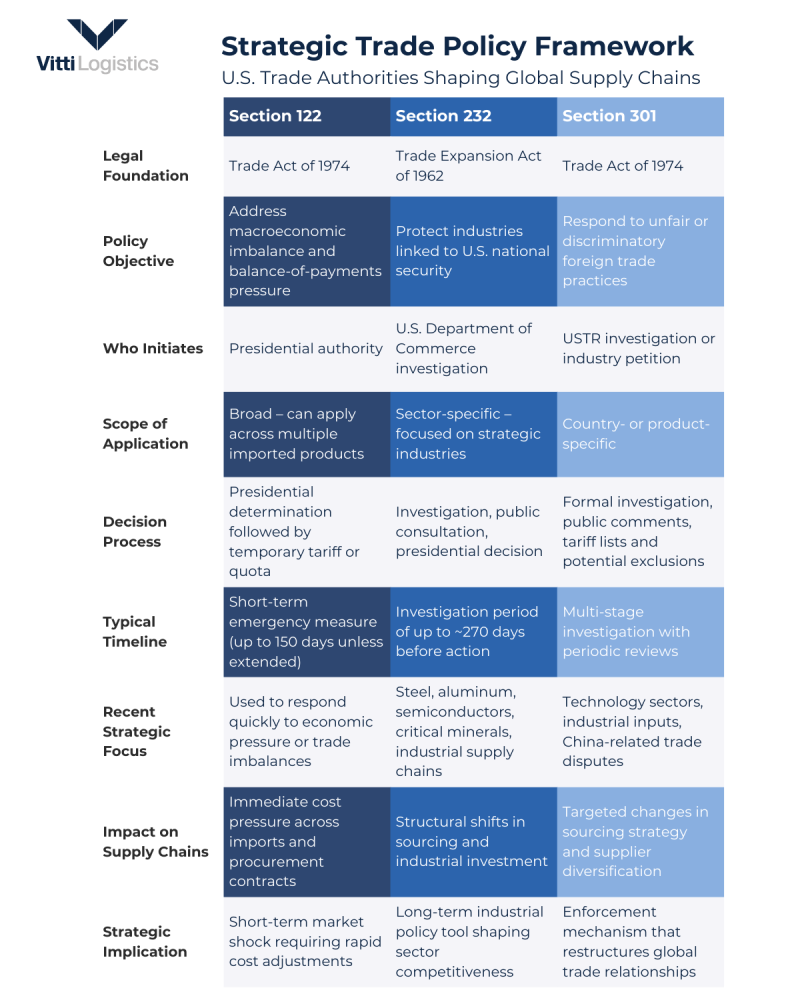
Sections 122, 232 and 301 represent three distinct policy instruments within U.S. trade law—each designed to address different economic or strategic objectives.
Three Authorities, Three Policy Signals
While often grouped together in headlines, these provisions serve very different purposes in U.S. trade policy.
Section 122 of the Trade Act of 1974 allows the U.S. president to impose temporary import surcharges or quotas in response to balance-of-payments instability or significant macroeconomic imbalances. By statute, these measures are short-term tools, limited to 150 days unless Congress authorizes an extension, with tariffs capped at 15 percent ad valorem.
This makes Section 122 fundamentally different from other tariff mechanisms. It is designed as a rapid economic pressure tool, not a permanent trade barrier.
Section 232 of the Trade Expansion Act of 1962 operates on an entirely different logic. It focuses on national security risks tied to critical industrial sectors. Investigations are conducted by the U.S. Department of Commerce, which evaluates whether imports threaten to impair national security.
Unlike Section 122, Section 232 measures often have longer-term industrial implications, as seen in previous actions affecting steel, aluminum and other strategic supply chains.
Section 301 of the Trade Act of 1974 is another distinct instrument. Administered by the Office of the U.S. Trade Representative (USTR), it allows the United States to respond to unfair or discriminatory trade practices that burden U.S. commerce.
Over the past decade, Section 301 has become a central tool in addressing structural trade disputes—most notably in relation to China—but its scope increasingly extends to broader sectors including technology, industrial inputs and even maritime logistics.
Why the Distinction Matters for Supply Chains
For companies sourcing globally or producing within North America, the practical implications of these authorities are significant.
Each mechanism sends a different signal to the market.
Section 122 creates immediate macroeconomic pressure. Because it can apply broadly across imports, it has the potential to affect pricing structures quickly. However, its temporary nature means companies must treat it as a short planning window rather than a stable policy environment.
Section 232 shapes industrial strategy. Measures introduced under national security concerns tend to focus on sectors considered essential for economic resilience. As governments increasingly link supply chain stability with national security, this authority has become a central lever for industrial policy.
Section 301 restructures competitive dynamics. Tariffs introduced through this process are typically country- or product-specific and can remain in place for extended periods. As a result, they often lead companies to reconsider sourcing models, supplier diversification and compliance structures.
For manufacturers operating in North America, these tools collectively encourage a deeper reassessment of regional supply chain resilience and trade compliance strategies.
Section 122 Expiration Watch
What Happens When the Clock Runs Out?
One development supply chain leaders are closely watching is the statutory expiration of Section 122 measures on July 24, 2026.
Because Section 122 is designed as a temporary economic stabilization tool, the authority to impose tariffs under this provision cannot remain indefinitely without congressional action.
As the expiration date approaches, companies importing into the United States face a key question: what happens next?
According to scenario analysis highlighted by Triangle Trade Intelligence, three different outcomes could emerge once the current measure reaches its statutory limit.
Scenario 1: The Tariffs Expire
The most straightforward outcome is that the temporary tariff simply expires.
If this occurs, import costs could decline immediately for affected goods. However, supply chains may still face short-term volatility as companies adjust contracts and procurement strategies that were structured around the temporary surcharge.
For some sectors, this could create a brief window of cost relief before the next phase of trade policy takes shape.
Scenario 2: Congress Extends the Measure
A second possibility is that Congress authorizes an extension, allowing the temporary tariff to remain in place beyond the current deadline.
This would prolong the pricing pressure on imports and signal that policymakers still view the measure as a useful short-term instrument to address macroeconomic concerns.
In this scenario, companies would likely maintain defensive sourcing strategies and continued cost adjustments.
Scenario 3: Policy Shifts to Other Trade Tools
The third scenario may be the most strategically significant.
Rather than extending Section 122, policymakers could shift toward other trade authorities such as Section 232 or Section 301, which allow for more targeted actions by industry or country.
If that occurs, the tariff environment could move from a broad macroeconomic measure toward more sector-specific trade enforcement, potentially affecting industries differently.
Nearshoring and the Strategic Value of North America
The growing use of these tariff authorities also intersects with another structural shift: the continued strengthening of North American supply chain integration.
As tariffs and enforcement measures reshape global trade flows, companies increasingly view Mexico and Canada as strategic production platforms within the USMCA framework.
However, nearshoring is not simply about geography. It also requires stronger capabilities in:
- rules-of-origin compliance
- supplier traceability
- tariff engineering
- customs risk management
- cross-border logistics optimization
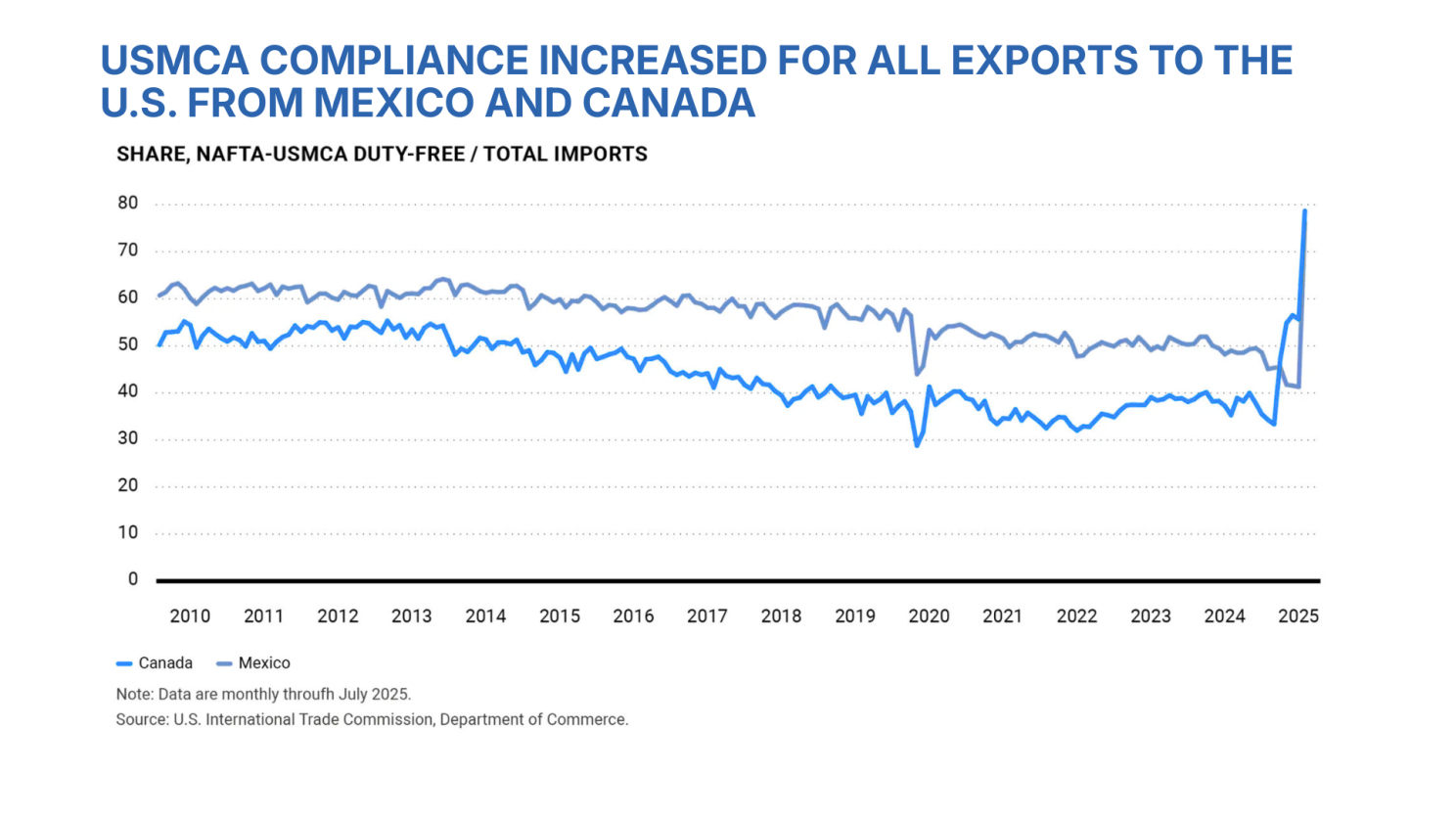
USMCA compliance on all Mexican goods imported increased from 49.5% in December of 2024 to 76.1% in July of 2025, while for all Canadian goods imported, compliance went from 35.5% to 78.7% during the same period
In this environment, trade policy is no longer just a regulatory issue handled by customs teams. It is becoming a core component of corporate supply chain strategy.
Strategic Insight for Supply Chain Leaders
The key takeaway is that tariffs are no longer a single variable.
Instead, companies must navigate multiple policy instruments operating simultaneously, each with different timelines and implications.
Section 122 may create short-term pricing pressure. Section 232 may redefine industrial protection priorities. Section 301 may reshape competitive dynamics across sectors.
For organizations serving the North American market, the competitive advantage will increasingly belong to those that understand how these mechanisms interact and how they influence sourcing, pricing and investment decisions.
In a world where trade policy is becoming more strategic, supply chain leaders must do the same.
VGPT Perspective
The evolving tariff landscape is a reminder that global trade is entering a period where policy, economics and supply chain strategy are deeply interconnected.
For companies operating across North America, staying ahead of these developments will be essential to navigating risk—and identifying opportunity.
Vitti Global Pulse of Trade (VGPT) provides executive-level insight on geopolitics, trade policy, and supply chain risk — translating complexity into operational clarity for North American businesses.
About Vitti Logistics
Vitti Logistics is a growing North American 3PL provider specializing in tech-driven, customized supply chain solutions. Our expanding “blue footprint” signifies our commitment to delivering reliable warehousing, transportation, and value-added services where industry thrives.
🌐 Learn more: www.vittilog.com
➡️ Subscribe to our newsletter and follow us for updates on the webinar date—don’t miss the insights that will shape the future of global trade.